


Do you remember mad minutes? I have pretty clear memories of doing them for multiplication. I remember loving them, because I loved math and liked the challenge. I particularly liked it when my teacher would instead do an oral version where she’d read out the questions. Those I always got 100% on, because if I didn’t know it immediately, I’d write down the question and come back on an easier one. Yeah, I was that kid.
Lately, as I’ve finally got back to playing around with my little pet (edtech) project, I’ve been thinking about how important it was to do these timed tests. I originally was thinking about it from the learning to read space (which is where my head normally is), specifically about fluency. Because one part of the definition of reading fluency is reading speed.
(I also had some recent conversations I’d had with one sister and a nephew about the multiplication times tables and mad minutes.)
I’m a firm believer that elementary school needs to be focused on mastering skills. And I really do mean mastering. You are building your foundation for all future learning. We often talk about the shift from learning to read to reading to learn, which emphasizes the importance of mastering learning to read before this shift. We don’t talk as often about the importance of early math skills, and how much each new grade builds upon the previous. And how if you don’t just know that 3x5=15, but have to pause and think about it each time, how much harder it’ll be to keep up each year.
Having knowledge that you just know – knowledge that doesn’t take you time to recalculate or to slowly decode, but knowledge that is immediately available at your fingertips – allows your mind to think about and solve bigger problems.
Just because you can look things up or use a calculator, doesn’t mean you shouldn’t be working to have base knowledge down pat.
Quick Math and Reading Skills
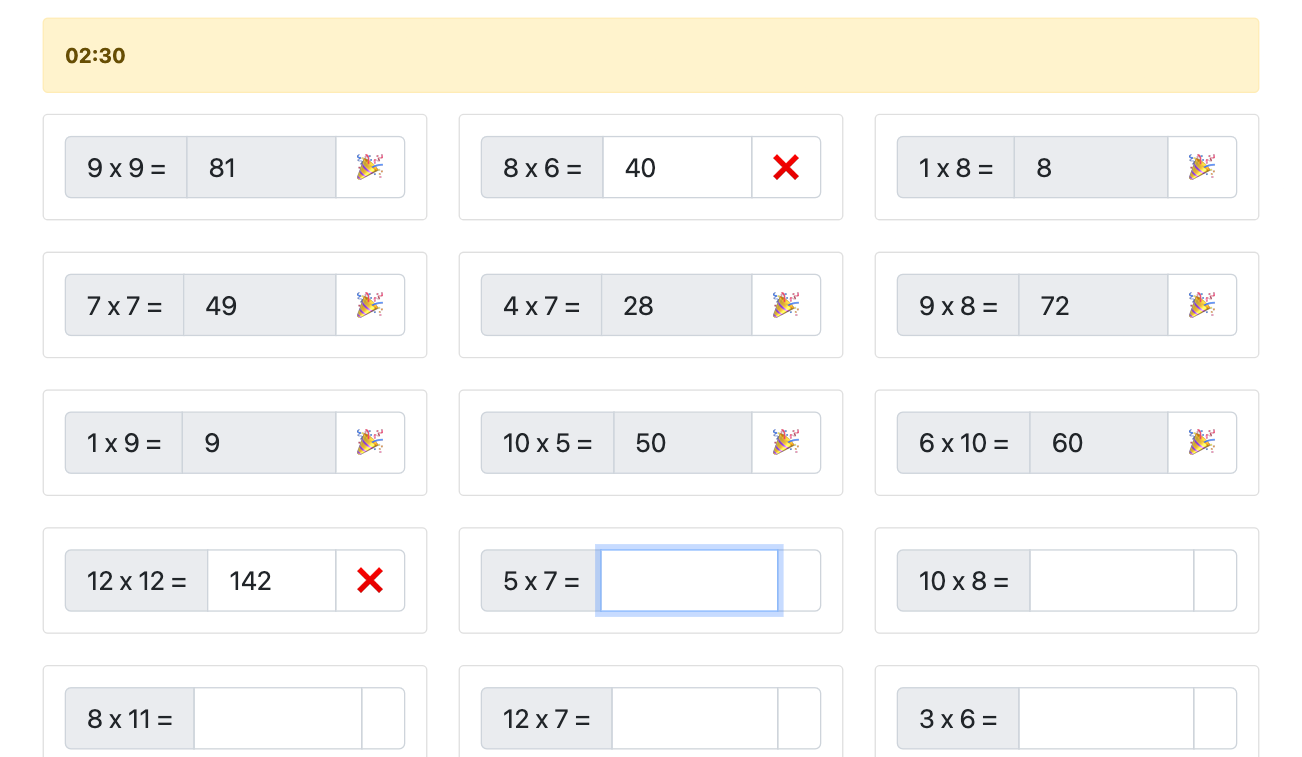
All this to say, when I finally got back to my pet project, I’ve been working on my own version of “mad minutes” although I’ve stretched the idea. I started from the premise of making one for multiplication, and I realized that to cover the times table from 1x1 to 12x12 there are 78 distinct questions when you ignore ordering (1x5 == 5x1). So, I thought, why not just ask all 78 questions at once and just randomly flip the order of each factor?
From there, I ended up with 4 math versions:
Single Digit Addition (1+1 to 9+9)
Single Digit Subtraction (1-1 to 9-9)
Multiplication (1x1 to 1x12)
Division (1/1 to 144/12)
The first two have 45 questions and the last two 78. For each of the four, I made 2 versions — one where you see all the questions at once (the image at the top) and another where it shows them one at a time. For each version, it corrects as you go. For the one at a time, it requires you to get the correct answer before moving on.
You can play around with them here (yes I don’t have it at a nice url yet).
I then circled back to reading, and have been slowly working on that side. So far, there’s only one version available to, which cover the top 100 high frequency words (split into two sets of 50). Right now it’s set to 5 minutes, which feels too long for 50.
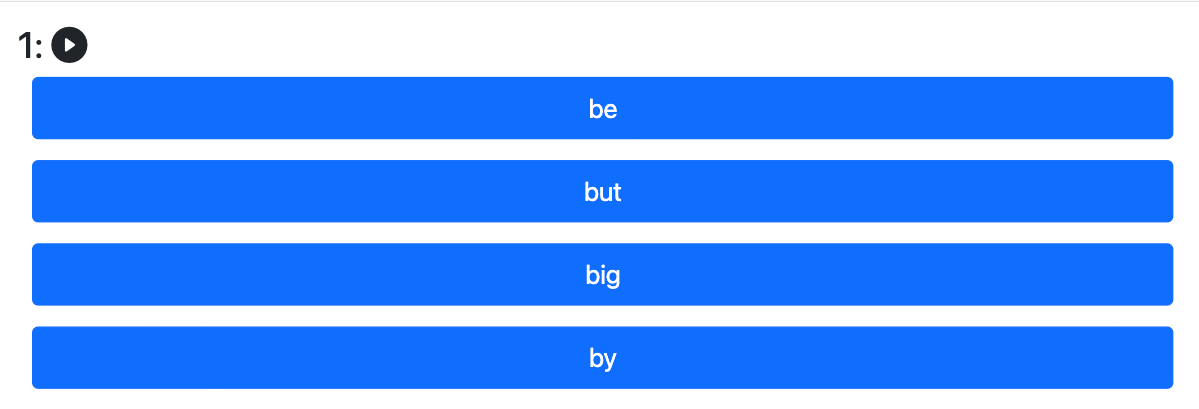
For the reading version, you listen to the word, and then have to pick the correct written word. It’s also available at the same site. (I’ve gone back and forth on whether this should be you see the word and then have to listen to 4 different options to pick the right one. And that version may still come about.)
I want to do some more that cover things like CVC or CVCe words. Or even just the base GPCs of a → ‘ah’.
A Starting Point
None of these are a full solution. They don’t teach. They are just a way for someone to practice a skill until they can do it quickly.
But, they’re a starting point for my project. When I think about early reading skills (or foundational math skills), I think a lot about how practice volume matters. That it’s important to stop looking for quick fixes and instead focus on real solutions. And real solutions when it comes to learning, mean spending time on intentional practice. And the more you practice, the better you get.
None of my little skill “tests” above, take more than 5 minutes to do. Imagine how much better you would get if you did one once a day for a month. Or how much better your students or kids would get.
1 month of the multiplication tables would take only 90 minutes (3 mins time 30 days). But at the end of it, you would answer upwards of 2,340 multiplication questions! Small investment, but big results.